A life of privilege and comfort has lead to willful ignorance, or the active denial of injustice, in the literary work of Herman Melville's Benito Cereno. From this author, we are able to interpret the parallels of privilege with United States politicians and their denial of climate change.
Global warming is the primary component of current climate change, and it is the result of a phenomenon known as the “greenhouse effect.” Long-lived gases such as water vapor, carbon dioxide, and methane that remain semi-permanent in the Earth’s atmosphere are what cause this “greenhouse effect.” These gaseous molecules act as insulators trapping heat radiating from the Earth’s surface that would otherwise dissipate into space. When humans burn fossil fuels, such as coal and oil, the concentration of long-lived gases in the Earth’s atmosphere rapidly increases. This endogenous input of long-lived gases by humans into our own atmosphere exacerbates the greenhouse effect in an exponential fashion. [1]
 |
| Taken from NASA |
The Intergovernmental Panel on Climate Change (IPCC) contains over 1,300 scientists from the United States and around the world. These scientists predict that the temperature of the Earth will rise 2.5 to 10 degrees Fahrenheit over the next century. A single say with this kind of temperature jump may not seem so bad, but to have these temperatures as the new norm, the world will start to see drastic changes to the Earth's ecosystems [2].
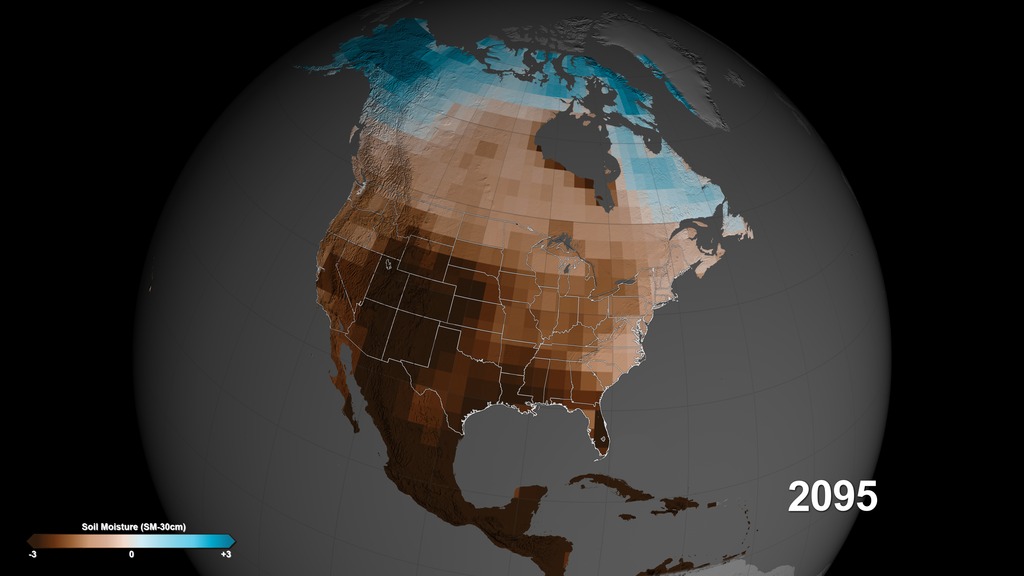 |
| Taken from SVS NASA |
Melville's, Benito Cereno, is told from Delano's perspective of romantic racism and class privilege. Since Amasa Delano is a white, middle-aged American, he represents the privileged class during this time period. Being part of this class allows him to disconnect from the reality of slavery. African slaves were viewed as animals rather than human beings, allowing their masters to not acknowledge what slavery actually meant. Delano refers to the slaves aboard the San Dominick, as domesticated animals that act upon the will of their owners, and not their own. It would be belittling to Delano, to identify slaves as being capable of such intelligence comparable to a man of his power.
While aboard the San Dominick, Delano saw three black and two Spanish boys sitting together on the hatches, scraping a rude wooden platter. When suddenly, one enraged black boy seized a knife and struck a Spanish lad over the head, producing a large bloody gash [4]. At first, Delano was taken aback that Don Benito claimed that the action was merely the sport of the boys. In those days, a violent act upon their "superior" race could lead a slave to their death. Yet, once seeing this dismissive response from Don Benito, he trusts his fellow privileged companion on how to handle his own slaves. Although Delano sees and understands that something is out of place, he is able to return to his disconnect towards slavery. He is able to return to this sense of comfort after every occurrence he sees upon the San Dominick. Even during the trials of Don Benito, Delano tells him "Forget it. See, yon bright sun has forgotten it all, and the Blue Sea, and the blue sky; these have turned over new leaves"[5]. Delano chooses to be willfully ignorant by turning to his privilege; that underprivileged slaves are incapable of ever revolting completely against their masters.
 |
| Taken from The Odyssey |
United States citizens view their politicians as leaders; bringing justice to the nation's people through their policies. By receiving this source of power, politicians can become blind to events that don't directly impact the nation's people. Though the United States will not see drastic effects of climate change on their soil any time soon, the leaders of the world should be looking out for countries that are underdeveloped. Politicians that choose to be willfully ignorant are actively denying the injustices that climate change will have on places of poverty. Like Amasa Delano, politicians see that climate change is happening, whether or not they believe to accept human's contribution. Even so, politicians are choosing to be willfully ignorant in order to eliminate the United States involvement on the matter. The United States is not singularly responsible for climate change, just like Delano wasn't responsible for the initial enslavement of Africans. But either way, hiding behind a place of privilege and power, deferring the blame and ignoring the truth, will in the end help no one.
Citizens that belong to the middle and upper classes of the United States, simply adjust to the effects of climate change. These social classes have enough money to adjust their everyday lives to increasing temperatures. Yet, what happens to the people who aren't privileged enough to adjust to increasing temperatures? These developing countries without sufficient funds will begin to struggle until the impacts are too detrimental on their societies. United States politicians are retreating into their comfort bubbles, disconnecting themselves from the reality these impacts have on underdeveloped countries because it has no effect on them.
____________________________________________________________________
[1] "A Blanket Around the Earth." NASA. climate.nasa.gov/causes/.
[2] "The Consequence of Climate Change". NASA. climate.nasa.gove/effects/.
[3] Gautam Naik. "How Will Climate Change Affect the Sahara?" The Wall Street Street Journal. 2014. wsj.com/articles/how-will-climate-change-affect-the-sahara-1401489555
[4] Herman Melville, Benito Cereno (Boston MA: Bedford/St. Martins, 2008), 48
[5] Herman Melville, Benito Cereno (Boston MA: Bedford/St. Martins, 2008), 106
[6] "Scientific Consensus: Earth's Climate is Warming". NASA. climate.nasa.gov/scientific-consensus/.

No comments:
Post a Comment